British Castle

Windsor Castle

Home -> England -> Berkshire -> Windsor Castle -> History

History

The area around Windsor has been a strategic site for several centuries. The Romans and the Celts are known to have built forts and hillforts around Windsor and Arthurian legend states that King Arthur once lived in a Celtic camp on the site of the present day castle. A 7th century Saxon settlement called Windlesora stood where the village of Old Windsor stands today.

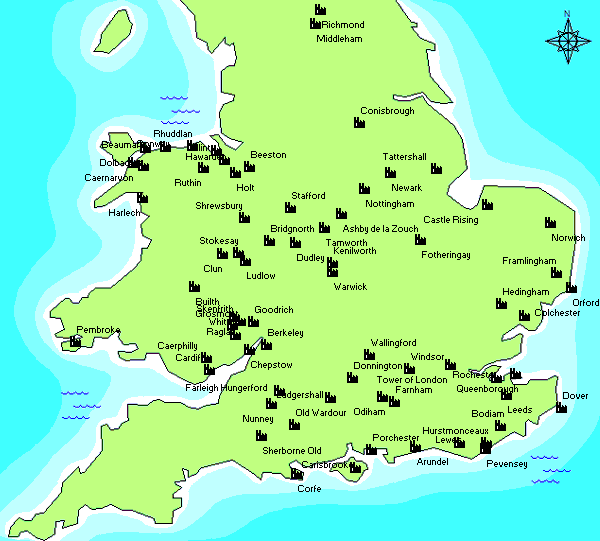
After the Norman Conquest of 1066, King William began to construct a ring of nine castles to protect London. The original wooden motte and bailey structure at Windsor was the first of these defences to be built.

During the reign of King Henry II, (1154–1189) a stone curtain wall was erected around the castle and the first Round Tower was built within the wall.

After the signing of the Magna Carta at nearby Runnymede in 1215, Windsor Castle was damaged after undergoing 2 sieges. The castle was repaired and fortified by King Henry III between 1220 and 1230.

Windsor Castle was an important retreat for the English monarchy who often found themselves out of favour with the masses. Throughout the castle's history, Kings and Queens improved it and added additional fortifications to ensure their safety.

King Edward III was born at Windsor Castle on 13 November 1312 and he began rebuilding the castle in 1350. Over a period of 24 years he demolished all of the existing buildings except the curfew tower and some minor outbuildings. The round tower was replaced by the present day keep, St George's Chapel was enlarged and he added additional fortifications to the fortress. It was Edward who established the Order of the Garter, a ceremony that still takes place annually within the chapel.

Although Edward III carried out extensive renovations to the property, St George's Chapel was close to collapse by 1390 and Richard II ordered its restoration. Geoffrey Chaucer, the famous author, was chosen as the clerk of the works for this project. With hindsight he was probably not the best choice because within 50 years the chapel was ruinous once more. The present day chapel was begun during the reign of King Edward IV in 1475.

Queen Elizabeth I moved her entire court to the castle during the Bubonic Plague in 1563. So worried was she about the spread of this disease that she ordered that anyone coming from London to Windsor be hanged at the newly erected gallows.

Windsor Castle fell into parliamentary hands during the English Civil War and became the HQ of Cromwell's army. Although Prince Rupert of the Rhine attempted to retake the castle early in the hostilities Cromwell held it from 1642 – 1649. The fortress was used as a prison and Charles I was held there after being found guilty of high treason. A bill to demolish Windsor Castle was read in parliament. Luckily this bill was defeated, but only by one vote.

After the restoration of the monarchy in 1660, King Charles II began restoring and refurnishing the castle. Charles got his inspiration from the Palace of Versailles and in addition to laying out the Long Walk he rebuilt the royal apartments and St George's Hall. These rooms were lavishly

furnished with tapestries and paintings.

Horse and carriage on the Long Walk, Windsor Castle
Photo: Moringo

Charles II died in 1685 and although the castle remained inhabited, successive monarchs preferred to live elsewhere. Windsor was not used as a royal residence again until the reign of King George III.

George III fathered 13 children and needed a large residence. He set about returning Windsor to its original medieval appearance and resigned the windows with a pointed Gothic arch. By 1811, King George had become deranged and he was permanently confined to the castle until his death in 1820.

His son, King George IV succeeded to the throne and in 1824 parliament approved £300,000 for major restoration work to the castle. It took 12 years to complete the work during which time the round tower, private apartments and the exterior of the south wing were completely redesigned.

The architect selected for this project was Jeffry Wyatville and he sought to make the castle look like a complete entity rather than a series of random buildings designed over the centuries. To achieve this, he raised the height of some of the towers, added Gothic style refacing and castellated battlements to the upper ward. Wyatville was also responsible for the addition of the 33 feet high hollow stone crown that can be seen atop the round tower. Sadly King George IV was not to see the completion of the works as he died in 1830.

Queen Victoria and Prince Albert established Windsor Castle as their main residence and in 1845 the state rooms were first opened to the public. Victoria and Albert also made changes to the surrounding parklands including the re-routing of roads away from the park. Prince Albert died in 1861 and for the next 40 years Victoria preferred to remain in Windsor, rarely visiting Buckingham Palace.

King Edward VII succeeded in 1901 and he preferred to live in the other royal residences. Windsor Castle remained empty for much of the year with the King just visiting at Easter and during Royal Ascot.

Although his successor, George V, also preferred the other royal residences, his wife installed new bedrooms and bathrooms on the upper floors and sought out new art works to furnish the state rooms. The royal Family at this time was known as the House of Saxe-Coburg and Gotha but in 1917, due to the anti-German sentiment caused by the First World War, they changed the name to House of Windsor.

During the Second World War Windsor Castle once again became a royal fortress. It was home to the young Princesses Elizabeth and Margaret. Their parents, George VI and Elizabeth remained in London to inspire and boost the morale of the country. Queen Elizabeth II succeeded her father in 1952 and Windsor Castle is now her principal weekend retreat.

Disaster struck the castle on 20 November 1992 when a fire broke out in the Queens' private chapel. Nine of the principal state rooms were destroyed and many others severely damaged. In total a fifth of the floor space was destroyed during the 15 hour blaze. It took until 1997 and cost £37 million to repair the damage.

Today Windsor Castle is used for state banquets and entertaining dignitaries as well as being used as a royal residence. It is also a major tourist attraction.

Castle Search
Windsor Castle

News & Events
Windsor Tattoo 2009
Local

Railway Stations
Windsor & Eton Riverside (0.25m)
Windsor & Eton Central (0.32m)
Datchet (0.98m)
Windsor Castle - Castle | History | Timeline | Map
England | N. Ireland | R. of Ireland | Scotland | Wales
Website by 10Home | News | Links | Contact Us